
Articles
Valdora Vaults Guide: USDC Yields & Tokenized Exposure

Discover how Valdora Vaults use USDC yield strategies and tokenized exposure to provide access to transparent, real-world yield opportunities.
Stablecoins have become one of the most important foundations of onchain finance. They allow users to hold value without constant exposure to market volatility, move capital across ecosystems, settle transactions quickly, and stay liquid while waiting for the next opportunity.
But stable capital does not have to remain passive capital.
USDC can sit idle in a wallet, or it can become the entry point into structured onchain strategies. Valdora Vaults are built around this shift. They turn USDC into programmable capital that can access curated yield strategies, real-world credit opportunities, systematic allocation models, and tokenized asset exposure through a single vault-based architecture.
This is where Valdora’s vault layer becomes important. It is not simply a place to deposit stablecoins for a headline yield. It is a framework for organizing capital, defining strategy exposure, issuing onchain position tokens, and connecting users to opportunities that were previously fragmented across traditional finance and DeFi.
What are Valdora Vaults
A Valdora Vault is a smart contract-based gateway to structured onchain strategies
Each vault accepts USDC deposits and allocates that capital into a specific strategy. The strategy may be linked to short-duration private credit, receivables-backed income, opportunistic credit, systematic market models, or tokenized asset exposure. Once a user deposits into a vault, a vault token is issued to represent that position onchain.
This vault token is a key part of the design. It acts as a tokenized representation of the user’s share in a selected vault. Instead of the position existing only as an internal record, it becomes visible and trackable onchain. Over time, this creates the foundation for composability, where productive capital positions can potentially interact with supported DeFi integrations.
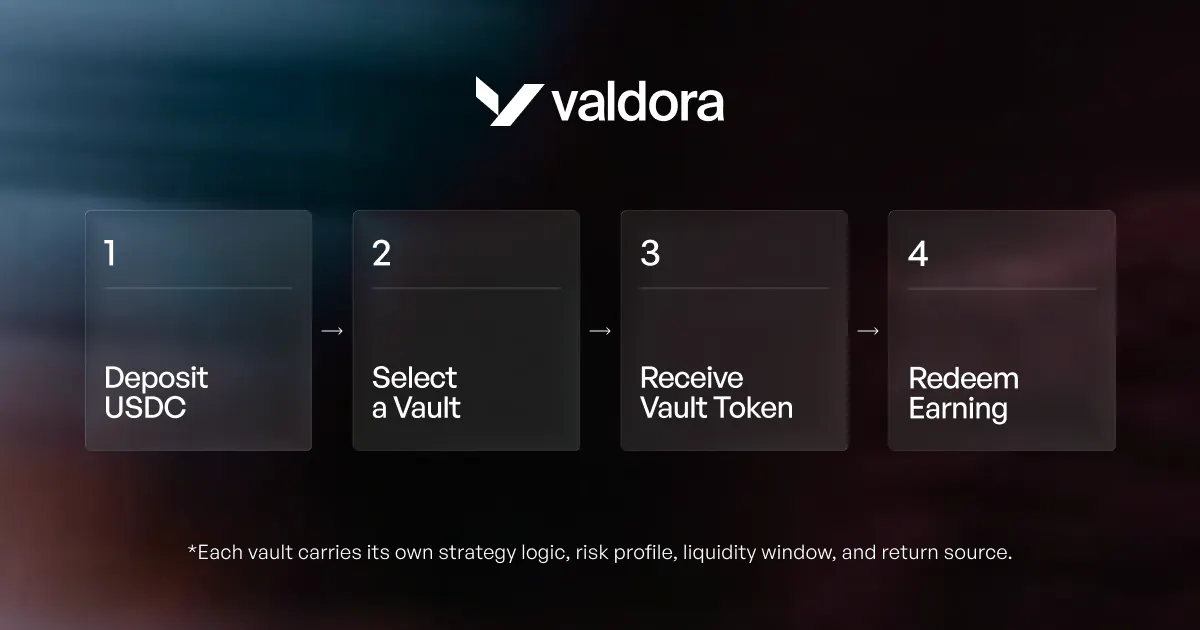
The structure is simple from the user’s side: deposit USDC, select a vault, receive a vault token, and redeem according to the vault’s terms. Under the surface, each vault carries its own strategy logic, risk profile, liquidity window, and return source.
That separation matters. A stablecoin vault is not the same as a tokenized equity exposure vault. Valdora Vaults are designed to make these differences clear instead of placing every opportunity under one generic yield product.
USDC as The Entry Asset
USDC sits at the center of Valdora’s vault architecture because it provides a stable, familiar, and liquid starting point for users.
Rather than requiring users to begin with volatile assets or navigate multiple tokens before accessing a strategy, Valdora uses USDC as the base layer. From there, the selected vault determines how that capital is deployed.
This creates a cleaner capital flow. USDC enters the vault. The vault issues a position token. The underlying strategy deploys capital according to its mandate. Returns, income, or market exposure are reflected through the vault position. When the user chooses to exit, redemption follows the vault’s stated settlement window.
In this model, USDC is not just a holding asset. It becomes the access rail into structured onchain products.
The Role of Tokenization
Tokenization is what turns a Valdora Vault position into an onchain financial asset.
There are two important layers to understand. The first is the tokenization of the vault position itself. When a user deposits USDC into a vault, the vault token represents that position onchain. It shows ownership of a share in the selected strategy and gives the position a more transparent digital form.
The second layer is tokenized asset exposure. Some vaults can use USDC to provide exposure to tokenized real-world assets or market-linked instruments. In this case, tokenization is not only about representing the user’s vault position, it is also about making the underlying exposure accessible through onchain infrastructure.
Together, these layers allow Valdora to support both yield strategies and asset exposure within one framework. A user can access income-focused vaults, credit-focused vaults, systematic strategies, or tokenized exposure without leaving the USDC-native vault environment.
This is the broader value of tokenization. It turns financial exposure into something that can be entered, tracked, and managed onchain.
Stablecoin Yield Vault: Real-World Yield From Short-Duration Credit
The Stablecoin Yield Vault is designed to connect USDC with short-duration private credit opportunities.
This strategy focuses on payment flows, remittances, invoice factoring, and working capital financing. These are areas where businesses often need liquidity for short periods of time. A payment operator may need to settle transactions before fiat clears. A remittance business may need temporary capital during settlement cycles. A company may have verified invoices but require liquidity before those invoices are paid.
The yield source is tied to real financing demand. It is not based on token emissions, circular DeFi incentives, or speculation on crypto prices. Returns come from financing spreads, fees, or repayment structures connected to real business activity.
This makes the Stablecoin Yield Vault one of the clearest examples of Valdora’s purpose: bringing real-world yield sources into an onchain vault structure while keeping the user experience simple.
Core Income Vault: A steadier Income Profile
The Core Income Vault is built for users looking for a more conservative income strategy.
Its focus is receivables-backed SME private credit. Small and medium-sized businesses often face timing gaps between delivering products or services and receiving payment. Receivables financing helps bridge that gap by providing working capital against expected cash flows, invoices, or payment obligations.
The Core Income Vault is designed around this more measured form of credit exposure. Its purpose is not to chase the highest possible return, but to prioritize steadier income, diversified exposure, and more predictable repayment behavior.
This vault plays an important role in the broader Valdora lineup because not every user has the same risk appetite. Some users may prefer stability and consistency over higher-yield opportunities. Core Income gives that type of allocator a more defined path.
Opportunistic Credit Vault: Broader Credit Exposure
The Opportunistic Credit Vault sits further out on the risk-return spectrum.
It is designed to access a wider range of private credit opportunities, including verified receivables, invoice financing, revenue-backed facilities, and short-term working capital structures. These opportunities may offer higher yield potential, but they can also involve more variability, broader borrower exposure, and different liquidity timelines.
This vault is not simply a higher-yield version of Core Income. It serves a different function. Core Income is structured around a more conservative profile, while Opportunistic Credit is designed to capture a broader opportunity set across private credit.
For users, the distinction is important. Higher yield potential should always be understood alongside the strategy’s risk, liquidity, and repayment profile. Valdora’s vault structure helps make that distinction visible.
Liquidity Should Match the Strategy
Every vault has its own liquidity profile.
This is critical because tokenized positions do not automatically mean instant redemption. If the underlying strategy involves private credit, receivables, market positions, or tokenized assets, redemption needs to reflect the time required for capital to settle, unwind, or recycle.
A short-duration credit strategy may offer a faster redemption window. A receivables-backed vault may require more time because invoice cycles and repayment schedules are longer. A tokenized exposure vault may follow market settlement timelines.
This is not a weakness. It is a responsible vault design.
A serious onchain capital product should align liquidity promises with the liquidity of the underlying asset. Valdora Vaults are structured so users can evaluate not only potential returns, but also strategy type, redemption terms, and risk exposure.
Building a Vault Layer for Onchain Capital
Valdora Vaults represent a more structured way to think about onchain capital.
USDC acts as the entry asset. Vaults act as the strategy layer. Vault tokens act as the tokenized representation of user positions. Underneath that structure, capital can connect with real-world credit, systematic allocation models, and tokenized asset exposure.
This brings together several important shifts happening across finance: stablecoin liquidity, real-world assets, tokenization, and DeFi composability.
The result is a vault framework that makes stablecoin capital more productive while giving users a clearer way to understand where their capital is going. Each vault has a defined purpose. Each strategy has its own risk profile. Each position is represented onchain.
Valdora Vaults are not simply yield products.
They are infrastructure for tokenized capital markets, built to make USDC more useful, real-world strategies more accessible, and onchain financial positions more transparent.
Frequently Asked Questions
What are Valdora Vaults?
Valdora Vaults are smart contract-based vaults that let users deposit USDC into structured onchain strategies. Each vault has its own strategy, risk profile, liquidity window, and return source.
What assets can users deposit into Valdora Vaults?
Valdora Vaults use USDC as the entry asset. Users deposit USDC into a selected vault, and the vault allocates that capital according to its stated strategy.
What is a vault token?
A vault token represents a user’s position in a Valdora Vault. When a user deposits USDC, the vault issues a token that tracks their share in the selected strategy onchain.
Where does yield in Valdora Vaults come from?
Yield depends on the vault strategy. Some vaults may generate returns from private credit, receivables financing, short-term working capital, systematic market strategies, or other real-world and onchain opportunities.
How are Valdora Vaults different from regular stablecoin holding?
Holding USDC keeps capital stable and liquid, but it usually does not create exposure to a strategy. Valdora Vaults use USDC as an entry point into curated yield strategies or tokenized asset exposure.
Are Valdora Vaults risk-free?
No. Each vault carries its own risk profile. Depending on the strategy, users may face credit risk, market risk, liquidity risk, smart contract risk, issuer risk, settlement risk, or concentration risk.
Are Valdora Vaults instantly liquid?
Not always. Each vault has its own redemption terms. Some strategies may require time for capital to settle, unwind, or recycle before a withdrawal can be completed.
How do redemptions work in Valdora Vaults?
When a user wants to exit, they request a redemption according to the vault’s terms. The redemption amount and timing depend on the vault’s strategy, performance, fees, liquidity window, and settlement process.